
The cost of corrosion to industry is a significant economic factor with far-reaching implications. Recent studies have estimated that it costs developed nations between 3 and 5% of their gross domestic product. For industrial operations, that cost is felt every time equipment fails, production stops or surfaces need replacing ahead of schedule.
Corrosion of metal is the electrochemical degradation of a material, metal or alloy, due to a reaction with its environment. When metals such as iron, copper, zinc and magnesium are exposed to corrosive conditions, their metallic elements go into ionic solution — a process known as disassociation. The rate at which this occurs varies with the electrochemical reaction present.
What needs to be present for corrosion to occur?
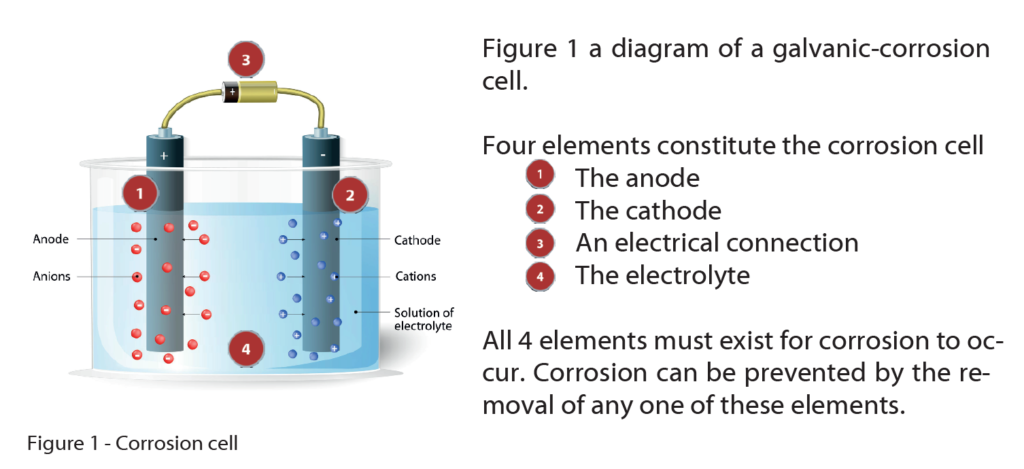
Four elements must exist simultaneously for corrosion to occur. Remove any one of them and the process can be prevented:
- Anode — the area that corrodes. Metallic elements go into ionic solution here.
- Cathode — the protected area.
- Electrical connection — the path between anode and cathode.
- Electrolyte — a liquid that conducts electrical current.
How can corrosion be stopped?
The process of corrosion can be slowed or halted by several methods, including metallurgical means, cathodic protection, inhibitors, design modification — and protective coatings. Protective coatings appear consistently as a control method across every primary form of corrosion: uniform, galvanic, crevice, pitting, erosion and microbiological.
How Chesterton ARC coatings help
ARC Industrial Coatings from Chesterton have been designed specifically to provide industry with an alternative approach to the protection of equipment subjected to extreme conditions — including corrosion, erosion and chemical attack. ARC products fall into the category of particle-reinforced polymer-matrix composites: engineered materials with performance capabilities beyond those of standard protective coatings, used specifically in applications where protection against severe abrasion, corrosion/erosion and chemical attack are the primary considerations.
The benefits include excellent chemical resistance, outstanding adhesion due to the high-performance polymers used, and the ability to be applied to any geometry or shape without special equipment or manufacturing — curing under normal ambient conditions.
Primary Forms of Corrosion
In our Glossary we describe many different types of corrosion. Please have a look in our sections below:
Microbiological Induced Corrosion (MIC)
« Back to Glossary Index